
How to clean teeth for someone with dementia? Do you find mouthcare for dementia sufferers difficult?
We are delighted to share this blog post by our great friend and elder care expert, Jane Peterson. Jane is the founder of Knowledge Oral Health Care offering practical oral care training for dementia, end-of-life care and compliance.
Read on.
Before a toothbrush is even seen, the mouth care experience has already begun.
What often unsettles a person is not the brushing alone. It is the suddenness of someone arriving, standing over them, speaking too quickly, or moving straight into their personal space before they have had time to orient.
In many care settings, the opening seconds are where the whole exchange is won or lost.
A familiar care moment looks like this: a caregiver approaches with good intentions, but they are also trying to stay on time. The toothbrush is already in hand. The resident turns their head, raises a hand, or stiffens before a word is spoken. From the outside, that can look like refusal. In reality, it may be a startled nervous system saying, “This is happening too fast.”
The first ten seconds deserve more attention than they usually get.
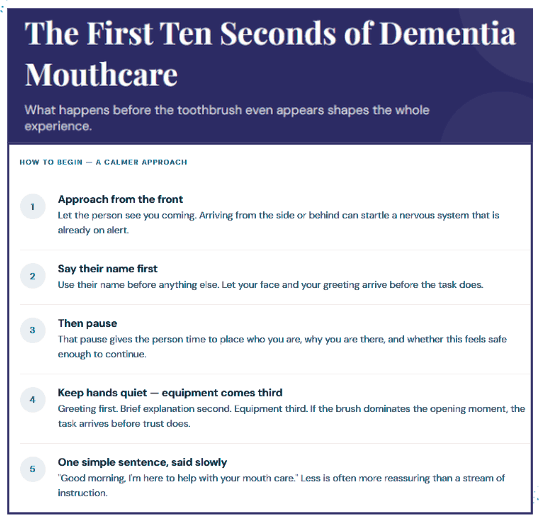
Start from the front, not from the side or behind. Let the person see you. Say their name. Let your face arrive before the task does.
Then pause…
That pause does not waste time. It gives the person a chance to place who you are, why you are there, and whether this feels safe enough to continue.
It also helps to keep your hands quiet at first. If the brush dominates the opening moment, the task can arrive before trust does. A calmer start is often: greeting first, brief explanation second, equipment third.
Language matters here too, but less is often better. One simple sentence, said slowly, is usually more reassuring than a stream of instruction.
Something like, “Good morning, I’m here to help with your mouth care,” can be enough.
Then watch…
Do the shoulders soften a little? Does the person look toward you? Do they keep their gaze on you rather than the door? Do their hands settle? Those small signs can tell you whether to move forward, slow down further, or leave a little more space.

If the person looks alarmed, do not rush to “fix” the moment with more talking. More words can add more pressure. Often, what helps most is a quieter presence, a softer pace, and one clear next step.
This is especially relevant for teams under pressure. When the opening is rushed, staff can end up meeting distress that then takes longer to settle. When the opening is steady, mouth care is often easier to support and less emotionally draining for everyone involved.
For managers and training leads, this is also a teachable part of practice. “How do we begin?” is just as important as “How do we brush?” If different staff open in very different ways, the experience becomes unpredictable for the resident and harder to repeat well across shifts.
A calm beginning is not a small thing. It is part of person-centered care.
It protects dignity because it treats the person as someone to approach, not a task to complete.
It supports consent because it allows space for the person to register what is happening.
And it supports staff confidence because it gives them a repeatable structure when the moment feels uncertain.

First shared on Linkedin May 2026, Dementia Mouthcare is a newsletter dedicated to compassionate, practical strategies that help caregivers support daily oral hygiene for people living with dementia.
If your team is reviewing how mouth care begins, there are practical resources for care settings at www.kohc.co.uk/paperwork-resources & www.kohc.co.uk/all-training.
Tips for toothbrushing can be found here. Products to support those who need extra care with mouth care can be found here.
About Jane –
I am a dental care professional with a Diploma in Dental Hygiene from the Eastman Dental Hospital, London, and over three decades of experience working across general and specialist periodontal practices in London, Hampshire, and West Sussex. Throughout my career, I have developed a strong grounding in both preventive and therapeutic care.
In 2014, completing a BSc in Oral Health Promotion broadened my perspective beyond clinical practice and reinforced the importance of prevention, particularly for people who may not have regular access to dental care. This marked a shift in how I approached oral health, not as an isolated clinical task, but as an essential part of overall wellbeing.
In 2015, I founded Knowledge Oral Health Care (KOHC) alongside other dental care professionals, with a clear focus on improving oral health within the care sector. Our work centres on educating and supporting carers, helping them develop the confidence and practical skills needed to deliver high-quality mouth care. Oral health is a fundamental aspect of personal care, yet it is still too often overlooked in healthcare settings.
Through evidence-based training, practical resources, and ongoing support, KOHC helps care services strengthen everyday practice and meet regulatory expectations, ensuring oral care is embedded into routine care rather than treated as an add-on.